Connectivity has evolved tremendously from an era when it was merely used to power the internet, to its numerous present day applications where it is vital to driving nearly every aspect of our livelihood. From our homes, medical equipment, transport, complex infrastructure projects to communication and many other fields that we cannot mention them all here.
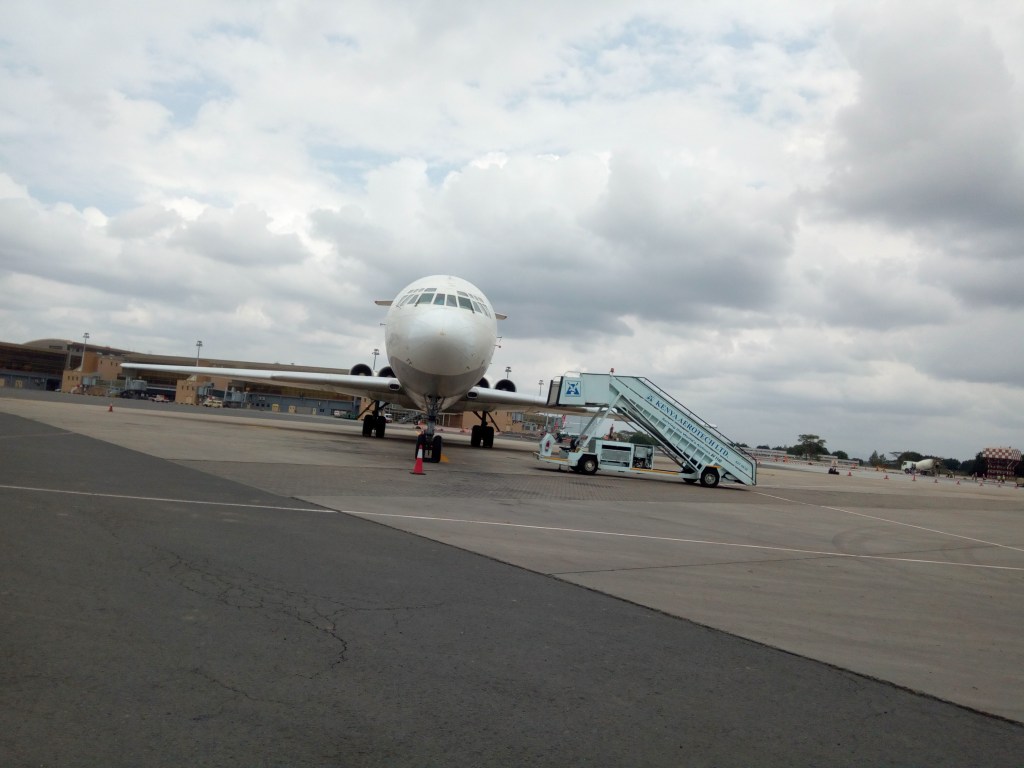
An airplane parked at Jomo Kenyatta International Airport
Advancement in connectivity led to the development of smart technology, which brought about convenience, efficiency and simplicity to processes of accomplishing certain results. This spurred an increase in the production of Internet of Things (IoT) devices, which again mounted pressure for the establishment of a suitable connection that would match network requirements of these devices and also be able to support multiple devices and a large volume of data at super fast speeds.
Up until 2019, the most commonly used connections were; bluetooth, Wi-Fi, 3G and 4G LTE. Each of these have their own limitations in terms of bandwidth, data transfer speeds and latency.
5G New Radio (5G NR) is the latest cellular network that was intended to succeed 4G cellular networks. With the promise of lightning fast download speeds up to 100 times that of 4G, and an extremely low latency, 5G will greatly facilitate the capabilities of IoT devices.
Latency is the delay between the sending of information and the corresponding response. Humans take approximately 180 to 200 milliseconds to respond to visual stimuli. 4G, with good connection has a latency of about 60 to 98 milliseconds. 5G promised a latency of less than 5 milliseconds, almost real time data transfer.
The advent of 5G networks raised several concerns, some of which were valid and called for investigations and subsequent mitigating measures while others have remained controversial hitherto. The valid concerns included claims that its deployment would; cause planes to fall out of the skies, interfere with weather forecasting reducing the accuracy of the collected data and interference with communications between satellites and C-Band stations (5G frequencies in the N78 and N79 ranges). Concerns which have remained to be controversial include: Claims that its high frequency non-ionizing radiation posses a danger to human health, that it was the cause of Covid-19 and also that it weakens the body’s immunity towards the virus.
All valid claims have already been addressed but we cannot discuss them all here. Since this site is dedicated to aviation content, will only talk about concerns to aviation.
Claims that planes would fall from the skies were quite due to possible interference of 5G signals with navigation systems of some planes. More specifically was the interference with the computer used to determine the height of airplanes above the ground. Airplanes are usually equipped with instruments which determine their position and status with relation to the surrounding environment, their flight-path, the ground or terrain and other nearby planes. For altitude information planes usually have altimeters which derive their data from an onboard air data computer. The computer gets air signals through probes that are normally fitted on the exterior surfaces of the plane. From the signal this computer determines the atmospheric pressure at any altitude which the plane would be flying and interpretes this as the plane’s altitude, based on the pressure which the pilot will have set as reference at sea level.

An analog altimeter display gauge used to show the plane’s altitude
However, due to varying atmospheric conditions, an altimeter cannot be relied upon to give precise height of the plane especially when the plane is near the ground and descending towards terrain.A more accurate and independent instrument that can continuously measure the absolute height of the plane above ground is required; and this is where a radio or radar altimeter comes in. The radio altimeter is usually active from the ground up to a height of 2,500 feet, past which its indications disappear and are replaced with an ‘OFF’ flag. The indications would re-appear again when the plane descends below 2,500 feet and remain active all the way to touch down. In fact most airlines have a standard operating procedure that requires one of the pilots to call out ‘Rad Alt Live’ soon as the indications re-appear.
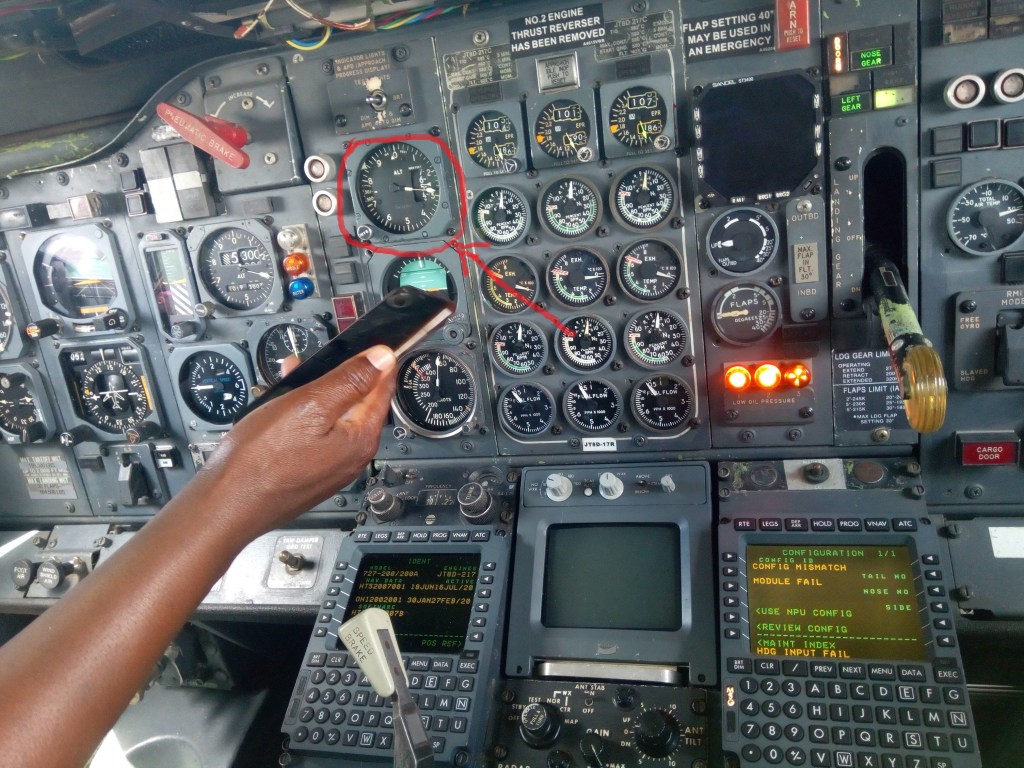
A radio altimeter indicator on a Boenig 727
A Radio Altimeter works by continuously sending radio frequency (RF) pulses towards the ground and receiving the signal which is reflected back to the airplane. It then computes the delay between the two pulses (transmitted and received) and interpretes this as the height of the plane from the ground. Based on this the radio altimeter sends signals to activate some systems such as aural warnings to the flight crew should it detect an unsafe condition. An example of an unsafe condition is if the plane descends too fast towards terrain, or if the plane is approaching the ground and is not configured properly for landing.
To protect communication systems from interference, transceivers usually have inbuilt filter circuits to block signals which are out of the desired frequency range and only let in a specific range of frequencies for processing. However, some filters are designed with features that can be penetrated by a tiny range of neighbouring frequencies. These unwanted frequencies would cause several things including interference with the signal being processed leading to distortion, ‘noise’, or degradation of the signal being processed.
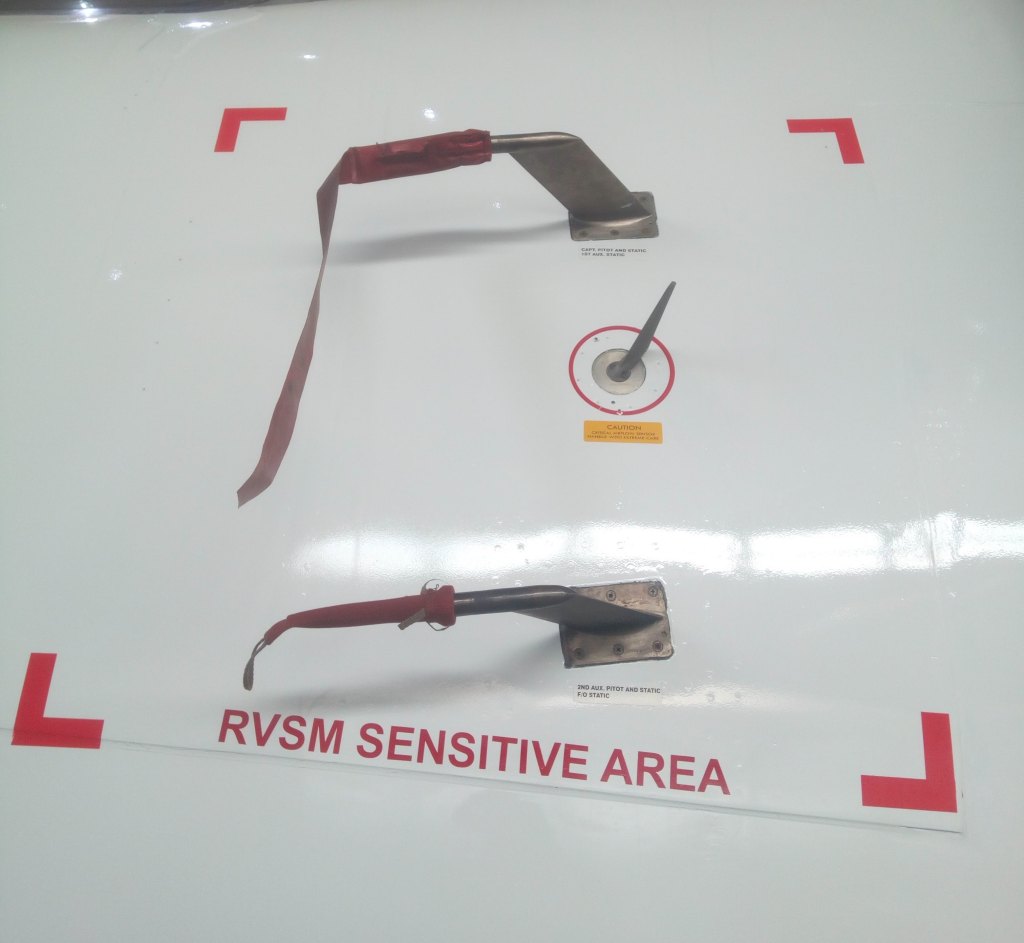
Some of the probes used to collect air data in flight
Radio altimeter RF pulses are usually transmitted at frequencies of 4,200 to 4,300MHz and at a rate of about 7000 pulses per second. Some older airplane models have Radio altimeters with filter circuits that can be penetrated by neighbouring frequencies, such as those in the 5G frequency range of between 3700 t0 3980MHz. This is likely to happen especially when the plane is near a source of these frequencies where the signal is strong, such as near a cell phone tower. This normally would be during a landing or take-off, which is also the phase of flight when the Radio altimeter is required to be fully functional. The result of this could then be that the system might process the false signal and mistake the height of the cell phone tower for the ground elevation, or the signal may cause distortion of the reflected signals being processed leading to erroneous interpretation of the plane’s height.
Height data from Radio Altimeter is usually not only displayed to the flight crew, but is also channeled to other related systems to either activate or deactivate some of their functions. Typically, some of the interconnect systems include: TAWS (Terrain Awareness and Warning System), TCAS (Traffic Collision Avoidance System), Autoland, PWS (Predictive Wind Shear), Crew Alerting System, PFDs (Primary Flight Displays) and others depending on the airplane model. All these systems are critical to the safe operation of the plane and feeding them incorrect data could be detrimental to flight safety.
However, the risk would only be applicable to flights within regions where the 5G frequency band deployed is near the operating range of Radio altimeters such as some regions in the United States. Flights within most parts of Europe, Asia and Africa where lower frequency bands are used would not be affected.
Mitigation to this issue included delayed deployment of 5G in some regions and near busy airports as investigations were conducted; which resulted in the development of modifications into existing vulnerable Radio altimeters, to make them more resistant to interference. Other recommendations included limiting power levels of 5G cell towers near airports and tilting the angle of 5G cell tower antennas near airports and flight paths so as to direct the emmited signal in a horizontal plane rather than upward into the receiver antennae of approaching airplanes. In the early days of 5G deployment some airlines went to the extent of swapping airplanes scheduled to land in the affected regions before resolutions were effected while few cancelled the flights to avoid the risk altogether.
However, application of 5G networks to aviation will bring about several desirable changes some of which include:
Enhanced airplane monitoring: With increasing adoption of modern technology in aviation, high speed data transfer, extremely low latency and reliable connectivity enable real time data transfer between airplane systems and ground stations. This will result in real time monitoring of airplane systems and engines; information which can be used to make critical decisions regarding the safe operation of airplanes.
Improved passenger experience: Fast and reliable connection on board planes and within airport lounges; that can also support passengers devices will make journeys more enjoyable and engaging. High connection speeds and low latency will greatly enhance data streaming services, real time access to online services and even high quality video conferencing. Travelers would be able to book or even make changes to bookings during any phase of the journey and business travellers would continue to be productive in flight via real time online video conferencing.
Improved communication: A high bandwidth , coupled with low latency will enable transmission of large volumes of data at lightning speeds; enabling real time transmission of aeronautical information including traffic, weather and advisory updates to operators. This will help in making timely decisions with regards to flight planning and consequently bring down costs to airlines and inconveniences to passengers that accrue from cases of air turn backs, aborted take-offs and landings or en route diversions.

 Aviation Talk